

When a company grows nearly 90% year over year, the outside world sees the obvious signs of success: revenue is up, new customers are coming in, infrastructure is expanding. The business is hiring, investing, moving forward.
But what is happening inside at the same time? What does that pace of growth really do to the organization behind the numbers? Can they truly keep everything under control while the business keeps growing around them?
Always eager to confront our own perspective with our customers’ real-world experience, Konrad Keck, Founder and CEO of EasyDCIM, reached out to Lucas Vanzin, CEO of EVEO, and invited him for a quick chat about growth, the pressure it puts on teams and systems, and what it really means to trust EasyDCIM with an operation that is growing this fast.
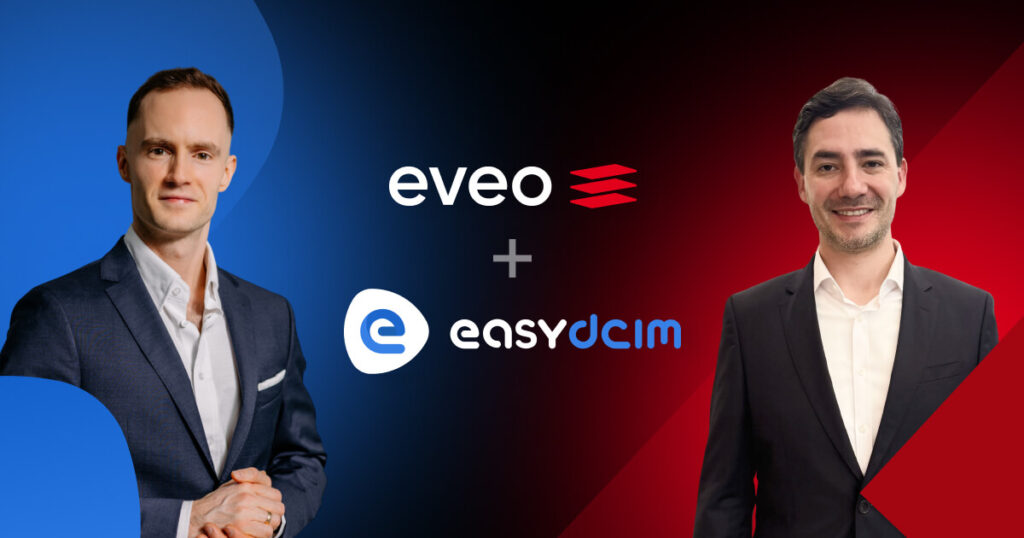
As Lucas explains, EVEO’s current position is the product of over two decades of steady work and hard-earned experience:
EVEO is recognized as the largest dedicated server company in Brazil and the leading reference in private cloud solutions in the country. A pioneer in the technology market for more than 25 years, we offer services across five Tier III data centers strategically located in São Paulo (Cotia and Osasco), Curitiba (PR), Fortaleza (CE), and Miami (FL), ensuring robustness and connectivity for both national and international operations.
This is not a young company trying to prove itself. EVEO is an established infrastructure provider that delivers services ranging from bare metal and private cloud to storage and disaster recovery. They know their market, understand their customers, and have built their reputation step by step. And that makes the recent acceleration even more interesting.
After achieving 60% growth in 2024, EVEO closed 2025 with a 90% year-over-year increase. The company is now moving toward an ambitious long-term objective of reaching BRL 500 million in revenue by the end of the decade.
For 2026, the expectation is to sustain this momentum, with projected growth of 60%, supported by structural investments and the maturation of demand for private cloud in the country.
At this level, growth becomes more than a commercial achievement, and starts radically changing the rhythm of everyday work. Every new customer adds another configuration to maintain. Every additional rack increases the number of devices that must be accurately tracked. Every new service must fit into workflows that are already stretched. The question is no longer whether the company can grow, but whether its internal systems can grow at the same pace.
First Layer:
Operational Capacity
Interestingly, EVEO’s challenge was not about fixing something broken. It was about recognizing that the existing working model would not carry the company safely into the next phase. Lucas describes it clearly:
Before EasyDCIM, we faced challenges mainly related to operational scalability. As the environment grew, it became increasingly complex and manual to maintain control, consistency, and integration across different elements, which made service growth inefficient. We also needed a tool that would help the team deliver in a more structured, process-driven way.
There is a big difference between surviving growth and preparing for it in advance. Manual coordination works for a while, experienced engineers compensate for gaps, and informal processes fill in missing structure. Over time, however, that approach becomes fragile, as it depends too much on individual effort and too little on system design.
EVEO was already using a DCIM solution, so the decision was not about adopting a new category of tool. It was about removing limitations that were starting to slow them down.
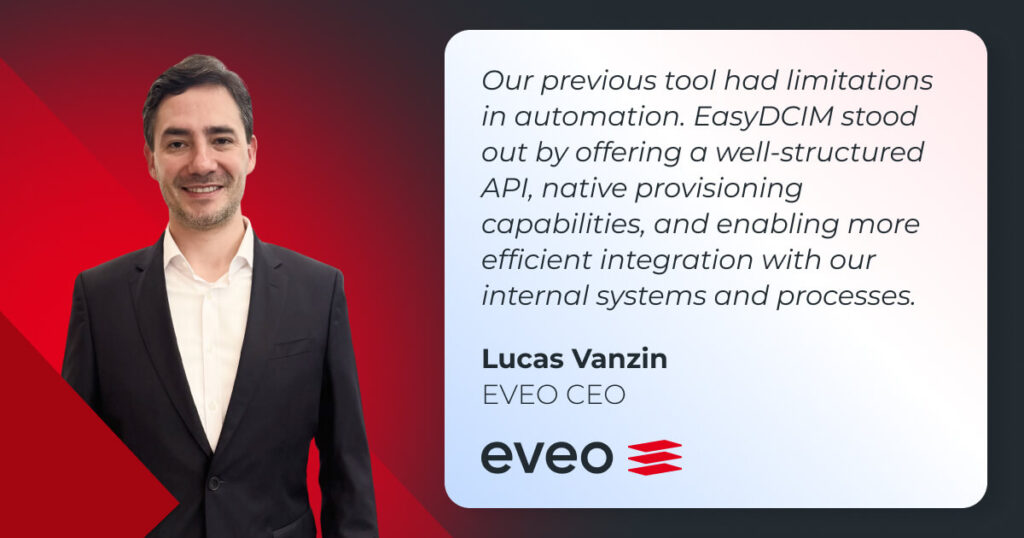
At a certain scale, automation is less about saving minutes, and more about protecting stability. A well-designed API and reliable provisioning flow determines whether systems cooperate naturally or constantly require workarounds. And workarounds do not scale well.
Second Layer:
Automation and Infrastructure Discipline
All the talk about growth means little if daily work still feels chaotic. For EVEO, one of the clearest moments where things began to feel more controlled came from something as practical as remote console access.
The most important feature for us is stable remote access via console (IPMI Proxy).
Anyone managing distributed hardware knows that console instability can quickly drain time and focus. When access is stable, troubleshooting becomes more straightforward and less stressful. Engineers can intervene quickly without questioning whether the tool itself will cooperate. Stability at this level reduces unnecessary escalation and shortens the path from issue detection to resolution.
Provisioning workflows also became more structured.
OS Provisioning has delivered clear gains in standardization and delivery speed.
As environments grow, standardization becomes a form of operational hygiene. It ensures that new deployments follow the same logic and setup patterns, even when volumes increase. This consistency limits configuration drift and lowers the risk of hidden configuration differences that might surface later.
Hardware visibility improved as well.
Another relevant aspect is the automatic discovery of device components, which strengthens inventory accuracy and facilitates integration between equipment.
Accurate hardware data tends to be secondary until a company grows across multiple data centers. At that point, it becomes clear how directly inventory accuracy affects planning, procurement, support workflows, and customer communication.
Third Layer:
Customer Experience
All of these adjustments would remain internal victories if they did not reach the customer base. The real test of operational maturity is whether users notice the difference. In EVEO’s case, they did.
For customers, EasyDCIM has contributed to a more organized and consistent operation. The feedback we’ve received mainly highlights greater access stability, reduced operational failures, and a more predictable service experience.
Predictability is rarely marketed as a feature. Yet in infrastructure services, predictability is what builds trust, and trust is what allows providers to build enterprise relationships without constantly compensating for instability.
Fourth Layer:
Control Supporting Growth
Looking at this from a broader industry perspective, many providers in Brazil and globally are entering similar high-growth phases. Would EVEO recommend EasyDCIM to companies operating in comparable environments?
Yes. EasyDCIM significantly increases the level of control and visibility over devices and infrastructure while streamlining data center operations. The combination of automation, reliable inventory, standardized provisioning, and stable remote access enables operations to scale with greater efficiency, predictability, and reduced operational effort, which is essential for growing environments.
Growth adds complexity by default. The real question is whether that complexity remains visible and manageable. Tools that provide control and transparency give leadership the confidence to keep expanding without wondering what they might be missing.
Lessons from EVEO’s Journey
Rapid growth tends to draw attention to numbers. What this conversation shows is that the real work happens elsewhere. It happens in the way systems are connected, in how processes are kept stable over time, and in the decisions that prevent complexity from getting out of hand.
In EVEO’s case, getting fundamental tasks better organized was a conscious step taken while the company was already moving fast, and that timing says a lot. You can say it’s easier to fix problems later than to prevent them early, yet they chose the harder route. Today, that choice shows up in smoother workflows internally and a more consistent experience for their customers.
EVEO’s journey is a vivid reminder that growth rarely slows down to wait for operations to catch up. And when the pace leaves little room for hesitation, EasyDCIM does exactly what it was built for: keep the business grounded while everything else is moving fast. Over time, that steadiness becomes one of the strongest advantages a provider can build.
Big thanks to Lucas Vanzin for sharing EVEO’s unique perspective and walking us through what growth looks like from the inside. It means a great deal to us to see EasyDCIM operating inside environments that move this fast and demand this level of discipline. It will be exciting to see how EVEO continues to grow from here. We will certainly be watching closely.